
Give Them Space
protect the weak and the small


Italo Calvino tells the story of Marco Polo traveling through many strange, mythical Invisible Cities. At the end of his journey, he described them all to the great Kublai Khan. But the Khan grew melancholy. He realized that every tale pointed to the same place: a single city sliding toward ruin.
“It is all useless,” the Khan said, “if the last landing place can only be the infernal city, and it is there that, in ever-narrowing circles, the current is drawing us.”
Marco Polo offered this counsel: “There are two ways to escape suffering it. The first is easy for many: accept the inferno and become such a part of it that you can no longer see it. The second is risky and demands constant vigilance: seek and learn to recognize who and what, in the midst of the inferno, are not inferno, then make them endure, give them space.”
Give them space. Protect the weak and the small. Bless the beasts (like Rev. Melody Perdue did last Sunday at St. Paul’s in Edenton) and the children, for in this world they have no voice, no choice. One of the most radical distinctions of Judeo-Christianity is precisely this: its insistence that the poor, the vulnerable, and the forgotten matter. That “what is not inferno” must endure, even when the powerful have already made peace with the flames.
Friedrich Nietzsche thought otherwise. He believed a healthy culture must exalt strength, power, and victory—not the weak. In The Anti-Christ he declared: “The weak and the botched shall perish: first principle of our charity. And one should help them to it. What is more harmful than any vice?—Practical sympathy for the botched and the weak—Christianity.”
That contempt for weakness would echo later in Nazi ideology. Soldiers of the Wehrmacht wore belt buckles stamped with Gott mit uns — “God with us.” Yet a glance through the Bible shows the truth: if God is with anyone, it is the widow, the orphan, the stranger, and the poor. As the Prophet Zechariah records: “Administer true justice; show mercy and compassion. Do not oppress the widow or the fatherless, the foreigner or the poor” (7:9–10). And Jesus: “Blessed are the poor” … “Let the children come to me, for to such belongs the kingdom of heaven.”
There is another story of seeing what is not inferno: Antoine de Saint-Exupéry’s The Little Prince, written in exile during World War II. Its watercolor simplicity fools us into thinking it is a children’s tale, but it is one of the most grown-up books ever written—about love, loss, and the wisdom of innocence.
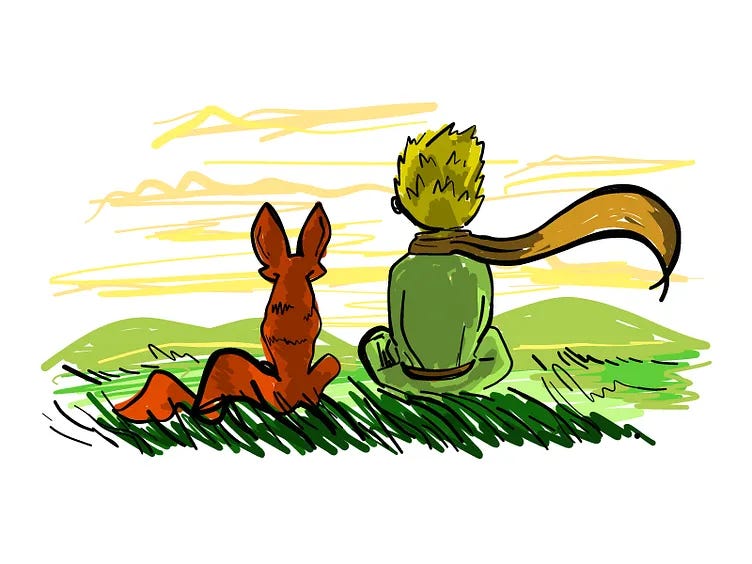
The Prince leaves his asteroid home and visits other tiny planets, each inhabited by an adult blinded by trivial pursuits. Only when he arrives on Earth does he learn, from a fox, the secret of love: “It is only with the heart that one can see rightly; what is essential is invisible to the eye. You become responsible, forever, for what you have tamed.”
The Little Prince, in the midst of inferno, recognized what was not inferno—his rose, his fox—and gave them space. He became responsible forever.
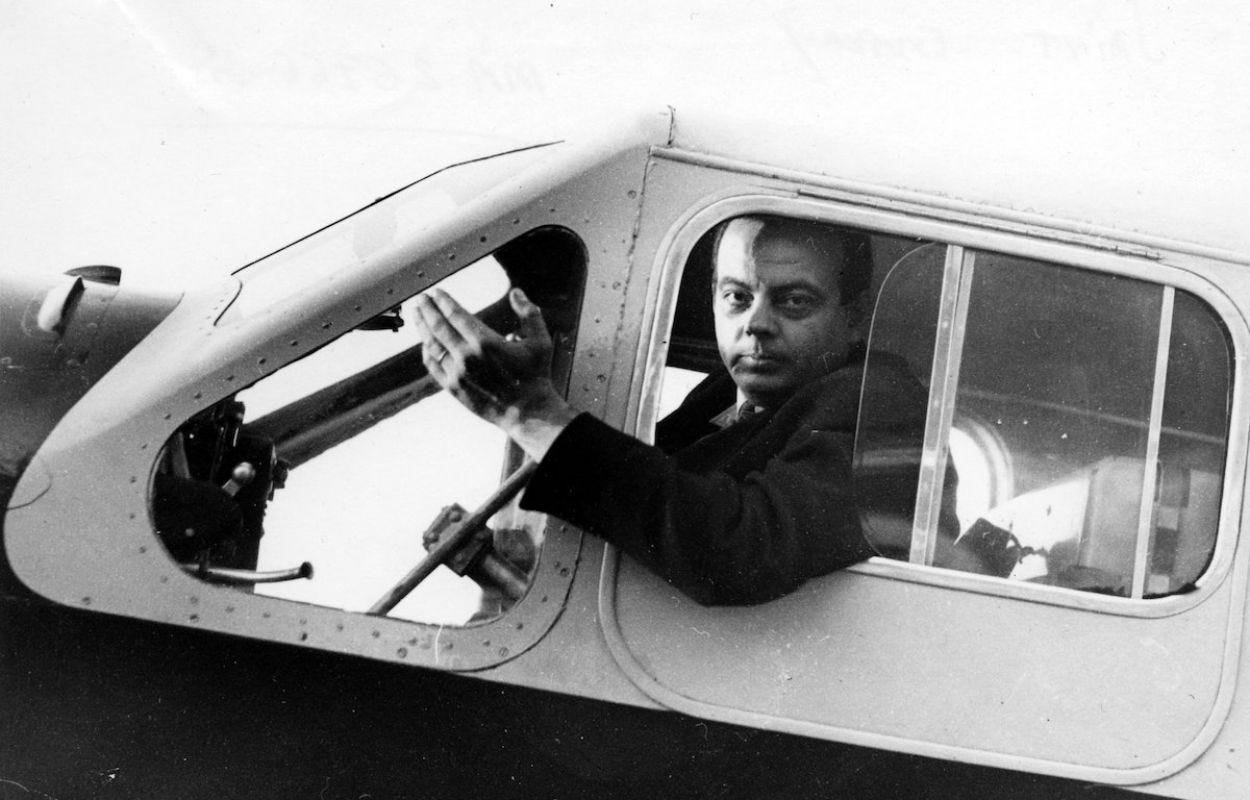
Saint-Exupéry himself was shot down by a Nazi pilot over the Mediterranean. The Luftwaffe pilot later realized the man he had killed was the author of the very book he cherished. His anguish lasted a lifetime—proof that to fight for the Reich is to inherit remorse.
Protect the weak and the small. In July 1941, when a prisoner escaped Auschwitz, the camp commander chose ten men to be starved to death. One cried out, “My wife! My children!” A Polish Franciscan priest, Maximilian Kolbe, stepped forward to take his place. Kolbe died on August 14, 1941. The man he saved, Franciszek Gajowniczek, survived to the age of ninety-three.
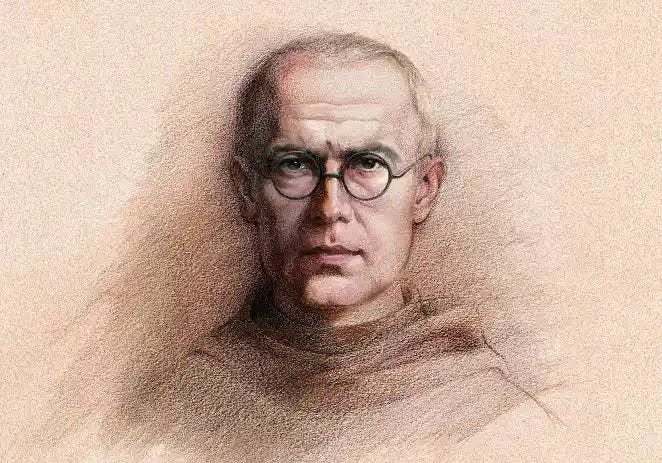
Saint Maximilian found what was not inferno and gave it space. He became responsible for another man’s life. This is what it means to live by the truth the fox taught the Little Prince: that what is essential is invisible to the eye.
And so must we. Protect the weak and the small. Seek what is not inferno, and make it endure.
I enjoy the perspective of Alan Watts, and based on his way of seeing things, which I find a deep familiarity with, he might say that even the inferno we’re asked to resist is also part of the dance.
Where we see what is not inferno and try to save it, Watts would remind us that the flames and the flowers are made of the same fire.
The task isn’t to escape the burning, but to awaken within it, to see that renewal and ruin move together, and that compassion begins when we stop seeing ourselves as separate from either.
Much like the presumptive writing on the belt buckles, we are all with god, it’s not reserved for one over the other and until we all act this way, despots conjure enemies to distract from their pathological ideologies.